Introduction
In the ever-evolving world of artificial intelligence, the integration of real-time data streaming and Retrieval-Augmented Generation (RAG) is paving the way for smarter and more efficient AI conversations. This innovative approach was recently highlighted at the Winter Data Meetup 2025, the below is a summary of the talking points, for more detailed presentation and learning more about the use cases and the solution architecture; please follow the link to watch the 25minutes recorded talk.
Understanding Large Language Models (LLMs)
The foundation of this approach lies in understanding the fundamentals of Large Language Models (LLMs). These models have evolved significantly from rule-based systems to advanced AI models, thanks to the impact of neural networks and deep learning on natural language processing (NLP). This evolution has enabled LLMs to serve a variety of use cases in various industries.
The business Value of LLMs and learning more about the industry-Specific Use Cases
LLMs and GenAI are being used across various industries, including healthcare, finance, retail, education, media, and logistics. These industry-specific use cases demonstrate the versatility and potential of AI in transforming different sectors.
Challenges and Solutions
While this approach offers numerous benefits, it also presents challenges such as inaccuracy, irrelevancy, and bias in AI models. By addressing these shortcomings through prompt engineering and context augmentation, we can improve the overall performance of AI systems.
Understanding the GenAI Model Lifecycle and how can we improve the LLM Model Output
To improve the outcome, we need to understand the GenAI Model Lifecycle. The lifecycle of GenAI models includes training, adaptation, deployment, serving, and feedback incorporation. Understanding this lifecycle is essential for developing and maintaining effective AI solutions.
The Role of Prompt Engineering
Prompt engineering plays a crucial role in eliciting accurate and relevant responses from AI models. By designing, refining, and optimizing prompts, we can ensure that AI models provide the best possible answers. This includes contextual prompting and system prompt engineering, which are essential for improving the quality of AI interactions.
Enhancing AI outcome with Retrieval-Augmented Generation (RAG)
RAG is a technique that enhances the output of generative AI models by utilizing facts retrieved from external data sources. This approach improves the accuracy and relevance of responses, making AI conversations more informative and reliable.
Integrating Real-Time Data Streaming
Real-time data streaming is another key component of this approach. By integrating real-time data, AI models can provide accurate and timely information, enhancing user experiences. This involves event-data streaming, which has evolved from the traditional pub/sub model.
A Practical Chatbot Use Case
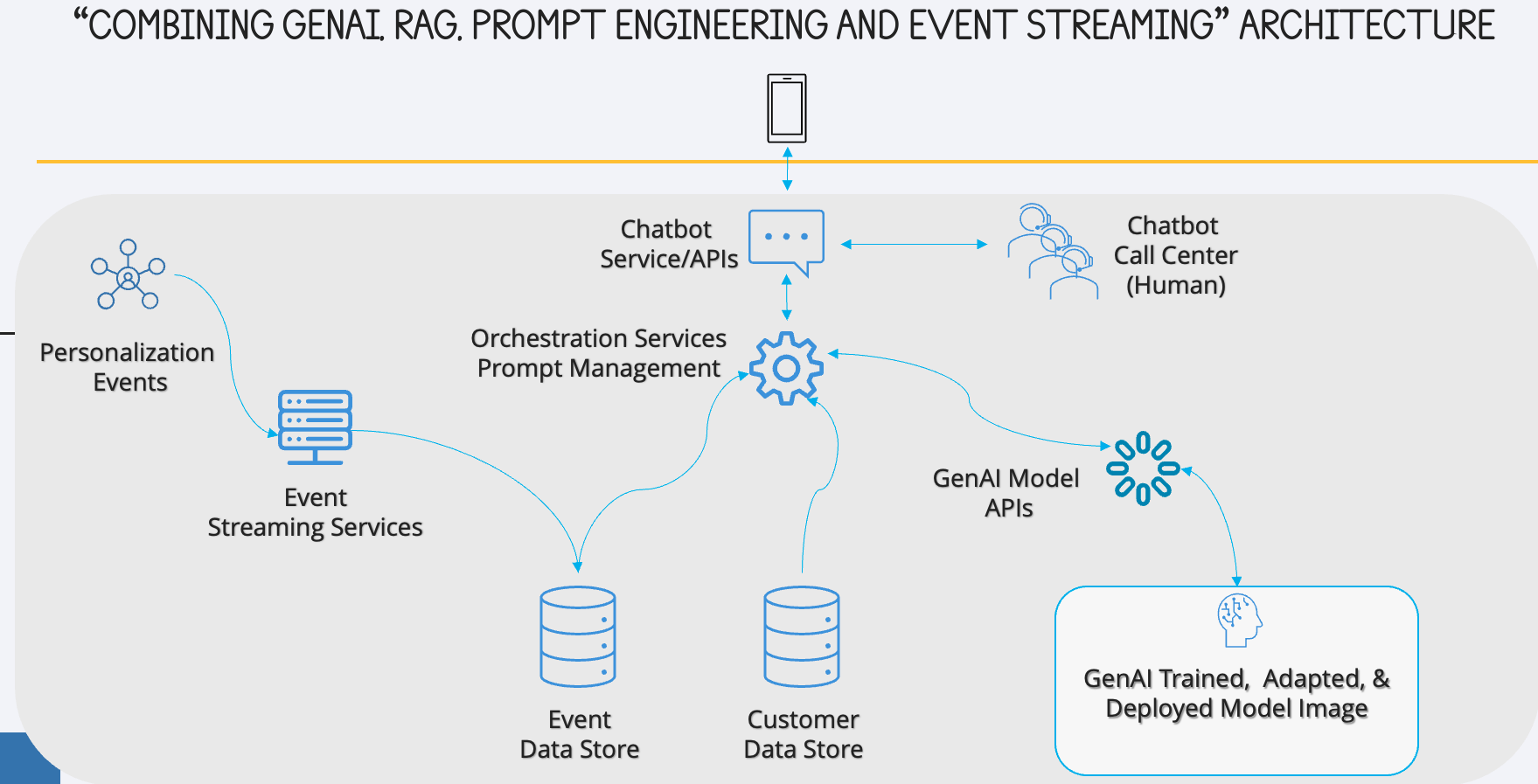
To illustrate the power of combining GenAI, RAG, prompt engineering, and event streaming, let’s consider a practical chatbot use case. In this scenario, a banking chatbot is designed to assist customers whose credit cards have been locked due to predictive fraud detection. The chatbot leverages real-time data and RAG to provide relevant and timely assistance, improving the customer experience and reducing the cost of human interaction.
Conclusion
Combining real-time data streaming and Retrieval-Augmented Generation (RAG) is a game-changer for AI conversations. By leveraging these technologies, we can create smarter, more efficient AI-driven solutions that enhance user experiences and drive innovation cross various industries.
 Mark Makary Blog
You must be logged in to post a comment.